





March 14, 2014
Urban Stormwater Management Fact Sheet
Federal requirements now require the clean-up of urban runoff before it reaches receiving waters. This fact sheet provides some least-cost methods for meeting these requirements – by using nature’s systems to handle drainage water.
Correction: In the “Urban Runoff Tied to Pollution and Flooding” section of this document, National Pollutant Discharge Elimination System (NPDES) was incorrectly referred to as National Pollution Discharge Elimination System. This has been corrected.
Download PDF: Urban Stormwater Management
A New Era of Stormwater Management
“Fines for violating new EPA runoff regulations are costly; traditional treatment methods are expensive. But there is another approach.”
-Art Baggett, Board Member, State Water Resources Control Board
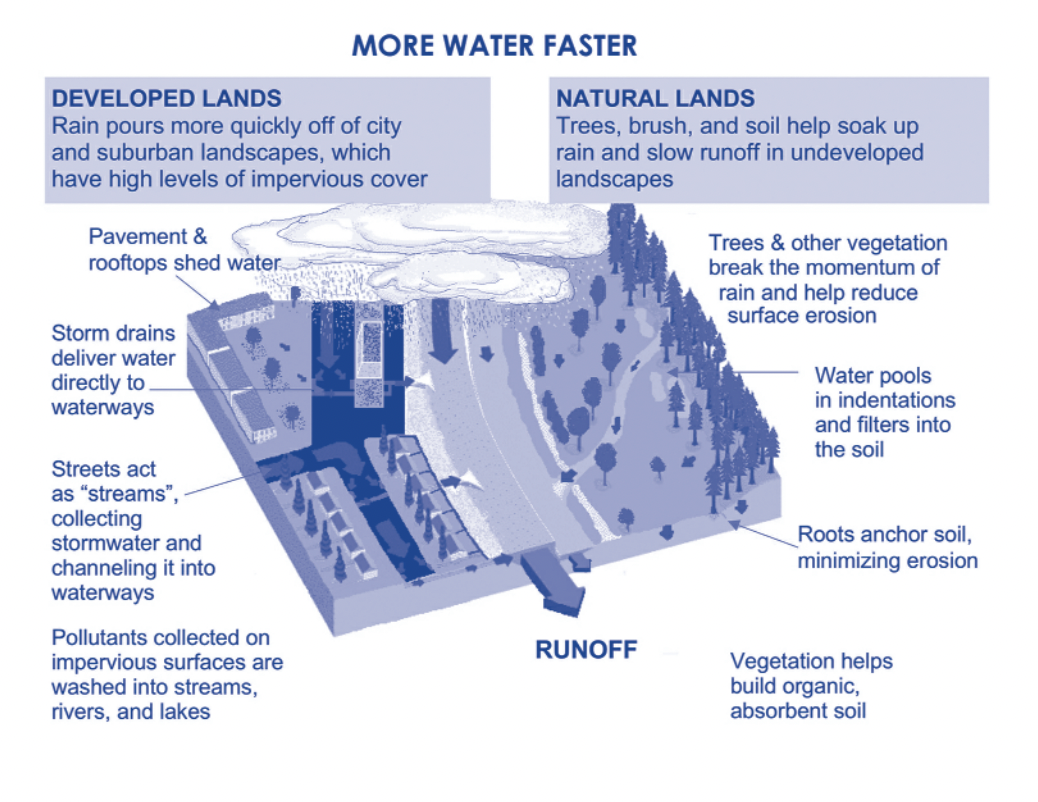
Urban runoff has escalated throughout the past century. The thousands of acres of paved surfaces that comprise our urban landscape today prevent rain and other sources of water from penetrating the soil. Instead, water rushes over impervious surfaces with escalating speed and volume, picking up an assortment of pollutants. Ultimately, this polluted water flows into gutters, channels and pipes and is delivered untreated into local waterways.
In the past, local government and developers relied upon engineering solutions to move stormwater as quickly as possible into concrete channels toward discharge locations. As a result, the pollution and sporadic overload of water entering waterways created significant environmental costs. Today, in the current climate of water quality regulation, these costs must be addressed. New, more acceptable stormwater management techniques use nature’s systems to handle drainage. They both improve water quality and reduce the risk of local flooding. They can be counted as best management practices for the purpose of National Pollution Discharge Elimination System (NPDES) permits.
Urban Runoff Tied to Pollution and Flooding
Urban stormwater runoff is water from precipitation and landscape irrigation that does not infiltrate into the soil. It flows over roadways and other hard surfaces in our urban landscape, picking up pollutants along the way.
Ultimately, this polluted water flows into gutters, channels and pipes, and becomes a concentrated “stew” of polluted water that is delivered – untreated – into local waterways.
As we cover over more land, less water can be absorbed by the soil. Thus, the volume of urban stormwater is increasing. This escalating volume of urban runoff not only increases pollution, it elevates the risk of flooding.
Urban runoff dramatically increases the risk of local flash floods.
Sun Valley – a city in the San Fernando Valley known for serious and chronic flooding – is developing a long-range plan to capture storm water to solve their chronic flooding problems. The City is creating much-needed park, recreation and wildlife habitat areas that will hold and absorb water during periods of heavy rain.
Runoff Pollution and Local Liability
The National Pollutant Discharge Elimination System (NPDES) has brought stormwater management to the forefront of local government agendas.
Municipalities are responsible for controlling pollution from urban runoff that enters waterways through stormwater systems. Cities, counties and the developers doing business in our communities must apply for permits to discharge urban runoff into waterways, and are subject to penalties from regulatory agencies if they discharge polluted water.
According to state documents, one California city was fined $468,000 in 2004 for illegally discharging polluted urban runoff into the San Joaquin River.
Economic Benefits of Reducing Urban Runoff
A natural drainage system often costs less to construct.
Example: The City of Seattle is redesigning residential streets with natural drainage systems by replacing paved street edges with tree-planted vegetated swales, cascades and small wetland ponds. The City is finding that natural drainage is 25% cheaper to build than conventional roadside drainage systems. These systems can also be less costly to maintain than the usual stormwater system that tends to get clogged with leaves during fall rains.
Replenishing local groundwater supplies using natural drainage can help avoid the purchase of more expensive water supplies.
Example: The Los Angeles Basin Water Augmentation Study, completed in April 2005, concluded that increasing infiltration of urban stormwater runoff for recharge of groundwater offers a viable alternative to relying solely on purchased water.
Using a natural drainage system avoids the extraordinary costs that result from floods.
Example: Over 20 community-based organizations came together to develop a plan to address the dual challenges of restoring the health of the Napa River and implementing a flood management strategy to protect Napa Valley communities.
This effort received the 1998 National Planning Honor Award from the American Society of Landscape Architects for its revolutionary solution to flood control – removing the existing systems of dikes and levees and allowing the river to run free.
The region expects to save $26 million annually by protecting 2,700 homes, 350 businesses and more than 50 public properties from flooding.
Village Homes Is Model for Urban Runoff
Featuring narrow streets, ample open space, large trees and other native vegetation, as well as an above-ground, natural stormwater system, Village Homes in Davis, CA – a residential mixed-use development of 240 residential units – is a model for integrating stormwater management into development.
A network of vegetated swales winds thorough the community, functioning as common open space most of the year. During a storm, this system captures and treats runoff as it is filtered through catchments, and into soils.
The system was designed to carry remaining water slowly to the City’s municipal facility; however, it works so well that the water never actually makes it there.
Local Strategies for Controlling Urban Runoff
Two Goals
Opportunities exist to control urban runoff at different scales – from an individual site to the neighborhood, to the region or watershed. At each scale, there are two goals that guide planning and design:
- Protect and restore natural areas.
- Use site design that minimizes imperviousness and maximizes permeability.
Strategies include:
- Cluster development to maximize unpaved areas.
- Pave using pervious materials.
- Work regionally to preserve open space.
- Day-light creeks, and restore wetlands.
- Use minimum width streets.
- Reduce the area of parking lots.
- Protect and plant trees – they reduce runoff.
- Design recreation areas that can hold runoff.
- Direct runoff from pavement and buildings to vegetation-lined channels.
Ideas for Implementation
Develop form-based codes that incorporate natural stormwater management techniques into community design.
Example: The City of San Jose is currently developing a form-based code that will design the water infrastructure for a 7,000-acre new development – Coyote Valley. The plan will allow rainwater to be captured and used to recharge the groundwater, the sole source of potable water for the new development. At the same time, the landscape plan will address problems of flooding on the site through the integrated use of swales, a lake, the restoration of a creek, and the creation of riparian corridors.
Develop new parking standards that reduce impervious surface area.
Example: The City of San Diego has developed new parking standards for intensive commercial zones. The revised standards include smaller parking spaces and driveways as well as guidelines to reduce imperviousness.
Require runoff to be held on site.
Example: The City of Emeryville requires that all projects creating one acre or more of impervious surface area incorporate post-construction stormwater treatment controls on site. These requirements apply to all projects creating 10,000 square feet or more of impervious area.
Ahwahnee Water Principles
Preamble
Cities and counties are facing major challenges with water contamination, stormwater runoff, flood damage liability, and concerns about whether there will be enough reliable water for current residents as well as for new development. These issues impact city and county budgets and taxpayers. Fortunately there are a number of stewardship actions that cities and counties can take to reduce costs and improve the reliability and quality of water resources.
Principle 3
Water holding areas such as creek beds, recessed athletic fields, ponds, cisterns, and other features that serve to recharge groundwater, reduce runoff, improve water quality and decrease flooding should be incorporated into the urban landscape.
Principle 4
All aspects of landscaping from the selection of plants to soil preparation and the installation of irrigation systems should be designed to reduce water demand, retain runoff, decrease flooding, and recharge groundwater.
Principle 5
Permeable surfaces should be used for hardscape. Impervious surfaces such as driveways, streets, and parking lots should be minimized so that land is available to absorb stormwater, reduce polluted urban runoff, recharge groundwater and reduce flooding.